
Proxy Type
- Mobile Proxies
- Residential Proxies
- ISP Proxies
- Datacenter Proxies
- Static Residential Proxies
- Shared Datacenter Proxies
- Rotation Residential Proxies
- Rotation Mobile Proxies
Available Countries
- Ukraine
- Belgium
- Czech Republic
- Denmark
- Finland
- France
- Germany
- Greece
- Ireland
- Italy
- Netherlands
- Poland
- Portugal
- Spain
- United Kingdom
- Australia
- United States
- Canada
- China
- India
- Saudi Arabia
- United Arab Emirates
- Israel
- Japan
- Korea
- Norway
- Thailand
- Switzerland
- Turkey
- Vietnam
- Philippines
- Indonesia
- Malaysia
- Mexico
- Brazil
- Argentina
- South Africa
- Venezuela
- Egypt
- Colombia
- Nigeria
- New Zealand
- Pakistan
- Taiwan
- Chile
- Kenya
- Peru
- Iran
- Germany
- United States
- Ukraine
- Belgium
- Czech Republic
- Denmark
- Finland
- France
- Greece
- Ireland
- Italy
- Netherlands
- Poland
- Portugal
- Spain
- United Kingdom
- Australia
- Canada
- China
- India
- Saudi Arabia
- United Arab Emirates
- Israel
- Japan
- Korea
- Norway
- Thailand
- Switzerland
- Turkey
- Vietnam
- Philippines
- Indonesia
- Malaysia
- Mexico
- Brazil
- Argentina
- South Africa
- Venezuela
- Egypt
- Colombia
- Nigeria
- New Zealand
- Pakistan
- Taiwan
- Chile
- Kenya
- Peru
- Iran
- Germany
- United States
- Ukraine
- Belgium
- Czech Republic
- France
- Germany
- Greece
- Ireland
- Italy
- Netherlands
- Poland
- Portugal
- Spain
- United Kingdom
- Australia
- United States
- Canada
- China
- India
- Saudi Arabia
- United Arab Emirates
- Israel
- Japan
- Korea
- Norway
- Thailand
- Switzerland
- Turkey
- Vietnam
- Philippines
- Indonesia
- Malaysia
- Mexico
- Brazil
- Argentina
- South Africa
- Venezuela
- Colombia
- Nigeria
- New Zealand
- Pakistan
- Taiwan
- Chile
- Kenya
- Peru
- Iran
- Germany
- United States
- Ukraine
- Belgium
- Czech Republic
- France
- Germany
- Greece
- Ireland
- Italy
- Netherlands
- Poland
- Portugal
- Spain
- United Kingdom
- Australia
- United States
- Canada
- China
- India
- Saudi Arabia
- United Arab Emirates
- Israel
- Japan
- Korea
- Norway
- Thailand
- Switzerland
- Turkey
- Vietnam
- Philippines
- Indonesia
- Malaysia
- Mexico
- Brazil
- Argentina
- South Africa
- Venezuela
- Colombia
- Nigeria
- New Zealand
- Pakistan
- Taiwan
- Chile
- Kenya
- Peru
- Iran
- Ukraine
- Belgium
- Czech Republic
- Denmark
- Finland
- France
- Germany
- Greece
- Ireland
- Italy
- Netherlands
- Poland
- Portugal
- Spain
- United Kingdom
- Australia
- United States
- Canada
- China
- India
- Saudi Arabia
- United Arab Emirates
- Israel
- Japan
- Korea
- Norway
- Thailand
- Switzerland
- Turkey
- Vietnam
- Philippines
- Indonesia
- Malaysia
- Mexico
- Brazil
- Argentina
- South Africa
- Venezuela
- Egypt
- Colombia
- Nigeria
- New Zealand
- Pakistan
- Taiwan
- Chile
- Kenya
- Peru
- Iran
- Ukraine
- Belgium
- Czech Republic
- Denmark
- Finland
- France
- Germany
- Greece
- Ireland
- Italy
- Netherlands
- Poland
- Portugal
- Spain
- United Kingdom
- Australia
- United States
- Canada
- China
- India
- Saudi Arabia
- United Arab Emirates
- Israel
- Japan
- Korea
- Norway
- Thailand
- Switzerland
- Turkey
- Vietnam
- Philippines
- Indonesia
- Malaysia
- Mexico
- Brazil
- Argentina
- South Africa
- Venezuela
- Egypt
- Colombia
- Nigeria
- New Zealand
- Pakistan
- Taiwan
- Chile
- Kenya
- Peru
- Iran
Interface Language
- English
- Русский
- 简体中文
- Español
- Deutsch
Payment Methods
 Crypto
 Visa/Mastercard
 Google Pay
Integrations
- API
Specifications

Pricing
- ISP Proxies
- Static Residential Proxies
- Shared Datacenter Proxies
- Rotation Residential Proxies
- Rotation Mobile Proxies
Top 9 alternatives for Evomi







Our Review

Last updated: 2026-05-16
Evomi is a Swiss proxy provider that has been building proxy infrastructure for over seven years. It offers five proxy product types, two beta scraping products, and a pricing structure that genuinely sits at the lower end of the market. The Core Residential plan starts at $0.49/GB, which is hard to argue with. This review covers the full picture: what the products look like, how the pricing stacks up, what the dashboard experience is actually like, and where the provider falls short.
The short version is that Evomi is a strong fit for individual developers, small teams, and data engineers who want ethically sourced proxies at competitive rates. It is not the biggest name in the space, but the product lineup is well-structured and the free trial entry point removes most of the risk from trying it out.
What Proxy Types Does Evomi Offer?
Evomi runs five distinct proxy products, which is more breadth than a lot of mid-sized providers offer. Here is the full lineup with the numbers that matter:
| Product | Starting Price | Pool Size | Coverage |
|---|---|---|---|
| Core Residential | $0.49/GB | 50M+ IPs | 195+ countries |
| Premium Residential | $2.15/GB | 100M+ IPs | 195+ countries |
| Static Residential (ISP) | $1.00/IP | 100M+ IPs | 150+ countries |
| Datacenter | $0.35/GB | 500K+ IPs | Multiple regions |
| Mobile | $2.20/GB | , | 195+ countries |
The split between Core Residential and Premium Residential is worth understanding. Both draw from real consumer devices, which means the IPs are registered under actual internet service providers rather than data centers. That matters because websites use IP reputation as a primary detection signal. An IP that has existed on a residential ISP for months looks fundamentally different to an anti-bot system than a freshly minted datacenter address. Core Residential gives you 50M+ IPs at the budget rate. Premium Residential gives you 100M+ IPs, presumably with stricter quality filtering applied before those IPs are offered to you. If you are hitting moderately protected targets, Core is fine. If you are running against serious anti-bot deployments on sneaker stores, travel aggregators, or financial platforms, the Premium tier is the one to test first.
Static Residential proxies, which the industry also calls ISP proxies, are a different animal entirely. Instead of rotating across many devices, you hold a fixed IP that is registered to a residential ISP. The IP does not change between requests, which is useful for workflows that require session persistence, like managing social media accounts or operating e-commerce seller profiles. At $1.00/IP, Evomi's pricing here is reasonable. Shared datacenter options drop even further on the per-GB rate, making them the right choice for speed-sensitive tasks where detection is not a concern.
Two additional products are currently in beta: a Scraping Browser and a Scraper API. These are higher-abstraction tools that handle JavaScript rendering and anti-bot countermeasures internally. They are worth watching but are not yet at the point where they should be the primary reason someone chooses Evomi.
Protocols and Session Configuration
Evomi supports HTTP, HTTPS, and SOCKS5 across its proxy products. On Core Residential specifically, UDP and QUIC are available as optional toggles. This is genuinely uncommon. Most residential proxy providers only cover HTTP and SOCKS5, so the QUIC support opens up use cases around testing modern web applications that have migrated to HTTP/3. QUIC is the transport protocol underlying HTTP/3, meaning requests travel faster over unreliable connections because they avoid TCP's handshake overhead. For web scraping specifically, this matters less than it does for browser-based automation, but it is good to have the option.
Sticky sessions are configurable from 1 minute up to 120 minutes through the standard endpoint format. If you need longer persistence, the _lifetime-1440 parameter extends the maximum to 1,440 minutes, which is 24 hours. There is also a hard session mode, which holds the same IP for as long as the underlying device remains connected. Hard sessions are less predictable in duration since they depend on the device owner's connectivity, but they are useful when you need genuine persistence rather than a timed window. One thing worth noting: IP whitelist authentication is not currently available. Authentication is username and password only. That works fine for most setups, but teams that use whitelist-based authorization in their infrastructure will need to factor this in.
Pricing in Detail
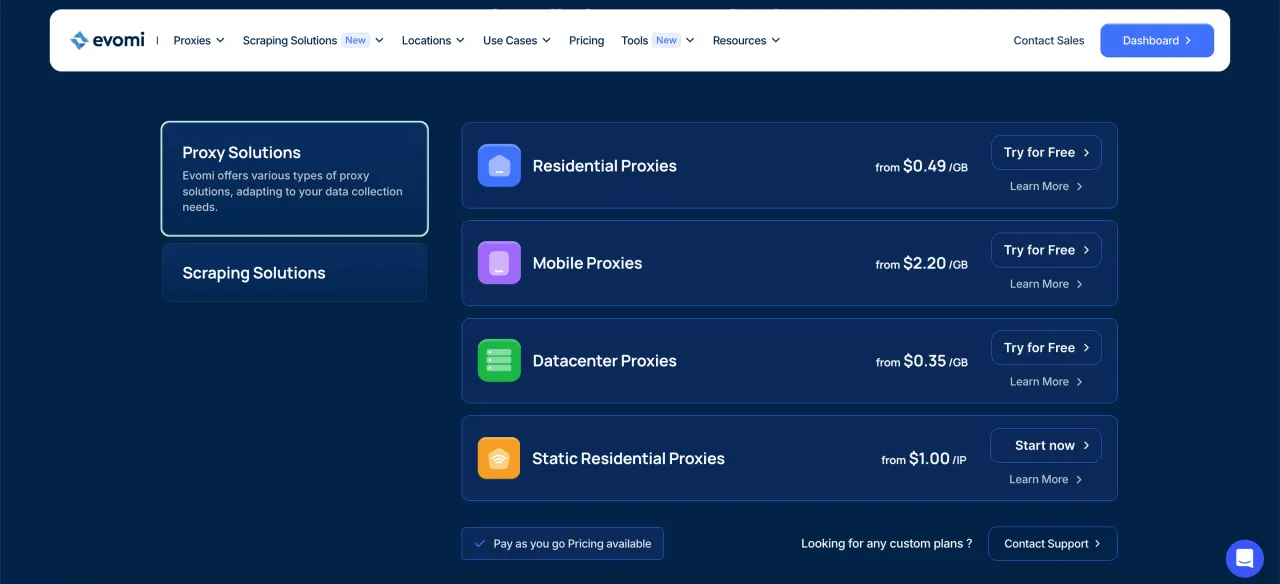
The headline number is $0.49/GB for Core Residential under a subscription plan. That is genuinely competitive. For context, the residential proxy market generally runs between $2 and $8 per gigabyte, with enterprise-focused providers sitting at the higher end and budget providers clustering around $2 to $4. Evomi at $0.49 is an outlier on the low side, which naturally raises the question of what gets traded off. Based on testing, the answer is pool quality relative to the Premium tier, not reliability or uptime in absolute terms.
The Datacenter product at $0.35/GB is equally aggressive. Shared datacenter proxies from established providers typically run $0.50 to $1.50/GB, so this sits well below the midpoint. For tasks like price monitoring on non-protected sites, content validation, or internal testing environments, datacenter proxies are the right tool and Evomi's rate makes them hard to beat on cost.
Volume discounts apply as usage scales. The per-GB rate on shared datacenter proxies drops as low as $0.30/GB at the 1TB tier. Pay-as-you-go pricing is available for buyers who do not want a recurring commitment, though the per-GB rate there is naturally higher. The money-back guarantee applies if less than 1GB or 10% of the purchased plan has been consumed, whichever threshold is hit first. That is a standard structure in this market and is fair enough.
Free Trial
Both Core Residential and Datacenter proxies offer a free trial with no upfront payment required. The checkout total shows $0.00, though billing details are still required to activate the trial. This is a common pattern among proxy providers and exists to limit abuse, since free proxy access without any friction tends to attract exactly the wrong kind of users. For legitimate developers evaluating the service, the requirement to enter billing details is a minor inconvenience rather than a real barrier. The free trial is a genuine zero-risk entry point, which is the right way to sell infrastructure products.
Dashboard and Usability
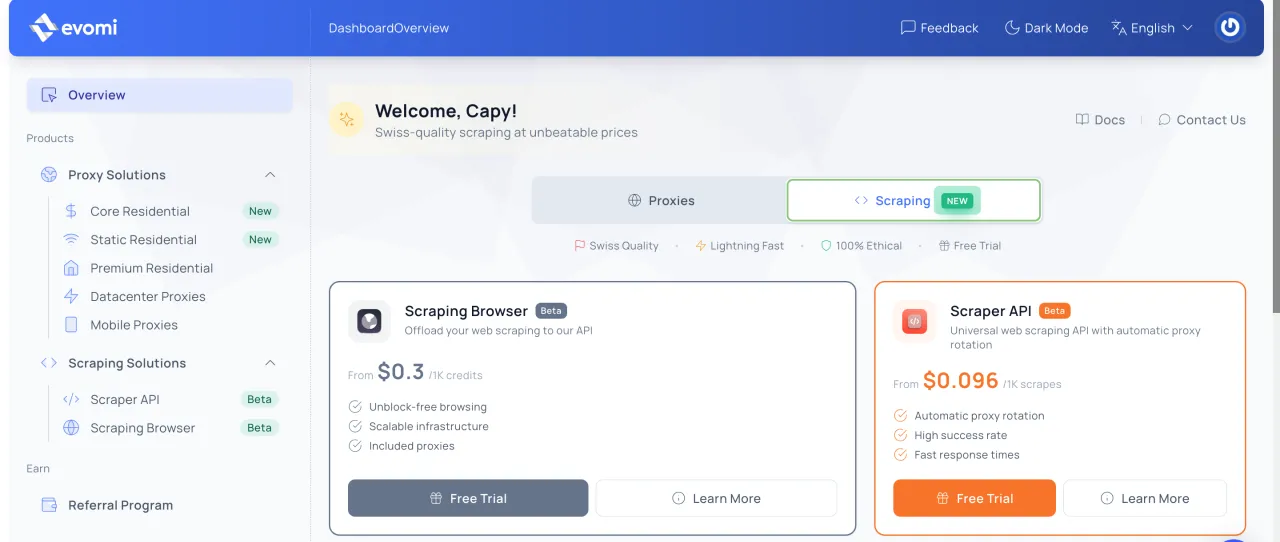
The dashboard is clean and well-organized. Proxy endpoint generation is straightforward: you pick the product, set the target country or city, configure the session type, and copy the formatted endpoint string. Targeting goes down to country, state, city, ASN, and ZIP code on residential proxies, which covers essentially every geo-targeting scenario a data collection workflow would need. ASN targeting (filtering by the specific network operator) is particularly useful when you need IPs from a particular carrier, which matters for mobile proxy use cases where the carrier fingerprint is part of what a target site checks.
The interface is more polished than what you see from some of the purely cost-focused providers in this space. This matters more than people tend to admit. A confusing dashboard slows down integration, creates configuration errors, and adds friction every time you need to spin up a new project. Evomi keeps things simple without hiding useful controls.
Support
Support deserves an honest assessment. Evomi operates with a live chat system that includes an AI agent component. The AI agent is fast and handles technical questions accurately, which covers the majority of what most users actually need: endpoint format questions, session configuration syntax, protocol compatibility, and similar topics. Human agents are available but not on a 24/7 schedule. When human escalation is needed and a human is available, responses are technically competent. The gap is availability outside of business hours, which is a real consideration for teams running scraping workflows across time zones.
Evomi confirmed directly through their support channel that no websites are blocked on their network. This is worth highlighting because some residential proxy providers maintain restricted target lists, which can create unexpected failures in production workflows and are not always disclosed prominently in product documentation.
Performance Numbers
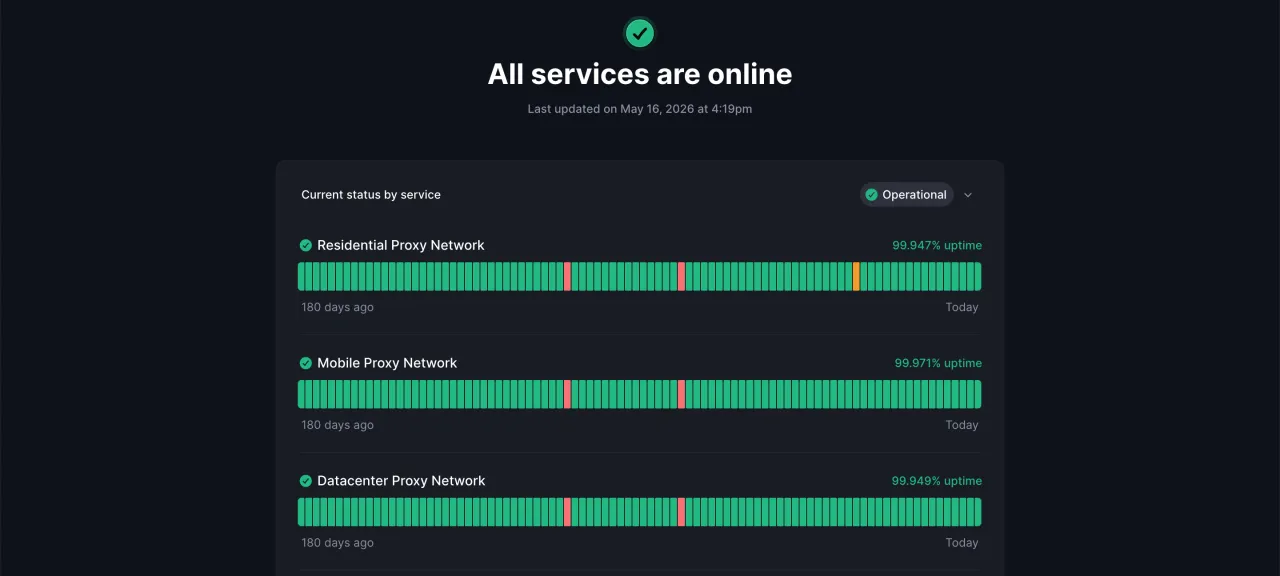
The success rate across residential proxy traffic sits at approximately 99.86%, with an average response time around 0.63 seconds. These are solid numbers. Response time in particular is a meaningful metric: residential proxies are inherently slower than datacenter proxies because the request travels through a real consumer device rather than a purpose-built server, and 0.63 seconds average is on the better end of what residential networks deliver. For reference, the slowest residential providers can run 1.5 to 2 seconds on average, which starts to compound into real throughput problems at scale.
Working Code Example
Below is a Python example using the requests library with retry logic, proper timeout handling, and session configuration for Evomi residential proxies. The requests library is the standard HTTP client for Python and handles proxy routing through a simple dictionary. The urllib3.util.retry.Retry class manages retries automatically so you do not have to write that logic by hand.
import requests
from requests.adapters import HTTPAdapter
from urllib3.util.retry import Retry

EVOMI_USER = "your_username"
EVOMI_PASS = "your_password"
# Using the _country-us_session-mysession123_lifetime-30 format
# The lifetime-30 means the sticky session holds for 30 minutes.
# Swap to _lifetime-1440 for the 24-hour maximum.
PROXY_HOST = "rp.evomi.com"
PROXY_PORT = 1000 # HTTP port for residential; use 1001 for SOCKS5

proxy_url = (
 f"http://{EVOMI_USER}_country-us_session-mysession123_lifetime-30"
 f":{EVOMI_PASS}@{PROXY_HOST}:{PROXY_PORT}"
)

proxies = {
 "http": proxy_url,
 "https": proxy_url,
}

# Retry on 429 (rate limited), 500, 502, 503, 504.
# total=3 means three attempts before raising an exception.
retry_strategy = Retry(
 total=3,
 backoff_factor=1.5,
 status_forcelist=[429, 500, 502, 503, 504],
 allowed_methods=["GET", "POST"],
)

adapter = HTTPAdapter(max_retries=retry_strategy)
session = requests.Session()
session.mount("http://", adapter)
session.mount("https://", adapter)

headers = {
 "User-Agent": (
 "Mozilla/5.0 (Windows NT 10.0; Win64; x64) "
 "AppleWebKit/537.36 (KHTML, like Gecko) "
 "Chrome/124.0.0.0 Safari/537.36"
 ),
 "Accept-Language": "en-US,en;q=0.9",
}

try:
 response = session.get(
 "https://httpbin.org/ip",
 proxies=proxies,
 headers=headers,
 timeout=(5, 30), # (connect timeout, read timeout) in seconds
 )
 response.raise_for_status()
 print(f"Exit IP: {response.json()}")
except requests.exceptions.ProxyError as e:
 print(f"Proxy connection failed: {e}")
except requests.exceptions.Timeout:
 print("Request timed out. Check session lifetime or proxy availability.")
except requests.exceptions.HTTPError as e:
 print(f"HTTP error from target: {e.response.status_code}")
The timeout tuple (5, 30) is a deliberate choice here. The first value is the connection timeout (how long to wait for the proxy to accept the connection), and the second is the read timeout (how long to wait for the target server to respond after the connection is established). Residential proxies can be slow to connect on the first handshake because the request is routing through a real device, so a 5-second connect timeout is more realistic than the default 1 to 2 seconds many developers use. Leaving the read timeout unbounded is a common mistake that causes scraping jobs to hang indefinitely on slow targets.
Who Should Use Evomi?
Evomi is a good fit for individual developers and small to mid-sized teams who want competitive per-GB pricing without sacrificing a usable interface. The Core Residential tier at $0.49/GB is genuinely one of the lowest rates available for ethically sourced residential proxies, and the free trial removes the usual friction of committing budget to an untested provider. The Swiss base and the emphasis on ethical sourcing matter to teams that have compliance considerations around how their proxy traffic is acquired.
Where Evomi is less suited is for enterprise buyers who need a dedicated account manager, contractual SLAs, or around-the-clock human support. Providers targeting that segment exist at higher price points and with correspondingly more hand-holding. For straightforward data collection, price monitoring, SEO crawling, ad verification, and account management workflows, Evomi delivers what is needed at a price that leaves room in the budget.
The product lineup is clean, the pricing is honest, and the free trial means there is no real reason not to test it against your specific targets before committing. That is a reasonable way to evaluate any proxy provider, and Evomi makes it easy to do so.
Visit Website Evomi












Previously, I used data center proxies and often encountered issues. After switching to ISP proxies, the situation improved significantly, and they are indeed more reliable.
ReplyThe original language is different from your language. The text has been translated automatically.